It's in my blood.
Since I was given my first camera, when I was a little kid, I have always been fascinated by capturing in a shot what my eyes were seeing around me. The beauty of nature or the smile of a friend, an event or an emotion... Precious pearls to be framed in a photo. Whether freezing a movement or moving the stillness, looking at normality through a different angle or portraying the exceptional, I can choose different perspectives, I can catch reality. I think this passion is in my blood, I inherited it from my Grandpa and then from my Dad, and it has always had a great influence in my life. Come and follow me in my journey searching impressions of life.


Showing posts with label bird. Show all posts

Sunday, April 15, 2018

The Eggs Hatched!

With great joy we experienced the hatching of all 4 eggs! It happened when it was very dark, so it was difficult to see, and the mother was kind in the way, nonetheless we are happy we have now four little blackbirds.

They are blind, with enormous eyes but still closed, and practically without any plumes. They can't really hold their heads up, but just for a few seconds when they get food from their Mom. She brings worms and larvae and she's very careful in perfectly cleaning the nest. The little ones' droppings are immediately collected – sometimes as they come out of the little bodies – and... eaten... yes, I know, kind of disgusting for us, but not in nature. Also, she's sure all the parasites are immediately taken care of.

Well, this is exciting! Enjoy a couple of extracts from the webcam!

Check also these other posts relating to the past and current blackbird visits
http://searchimpressions-life.blogspot.it/2018/04/blackbird-nesting.html
http://searchimpressions-life.blogspot.it/2015/04/sad-news.html 
http://searchimpressions-life.blogspot.it/2015/04/happy-easter.html


Saturday, April 14, 2018

Blackbird Nesting

For the third year in a row, blackbirds are nesting on our terrace. The first year they chose a pot, making the nest close to the root of the plant. The female laid three eggs and we were able to check the nest thanks to a small webcam. Unfortunately, a magpie came and stole the eggs, and the parents abandoned the nest. [you can see what happened here https://searchimpressions-life.blogspot.it/2015/04/sad-news.html]

Last year they (or another couple) made the nest in a safer spot, among the branches of our jasmine, in the corner against the wall, but again something went wrong, because the female abandoned the nest and two eggs, without a reason I could understand.

I left the nest there and this year she's back again, on the same nest. She's been brooding for at least a couple of weeks, so we should be almost there. She stays most of the time on the nest, sometimes turning the eggs with her beak. But once in a while she leaves... sometimes for ten minutes, sometimes more... It helps maintaining the correct temperature of the eggs, but every time we keep our breath: will she come back? So far she has always come back. We are crossing our fingers. Still a long way to go!

P.S.: Don't worry, the birds are not disturbed. The camera is very small and hidden, and remotely controlled. :)


Sunday, April 16, 2017

The King

The Kingfisher, a blue rocket that dives at incredible speed and precision to catch the fish. This beautiful bird is not rare but being able to see it fishing is not that easy, especially considering its speed. I have seen this bird diving from the top of a big tree, 15 meters high, into a small pond and still catch the fish, of course all in a flash.

Taking pictures of the Kingfisher is great: the shape and colors of this bird make it a perfect subject for a nature photographer. However, even if a portrait shot is already a great picture – considering the beauty of this bird – taking a shot in flight is the ultimate goal of every photographer. And considering the speed of the Kingfisher, that is no easy task. So... of course I tried to do that.

Because of how fast it is, the camera must be set on a very fast shutter time – to be sure to freeze the bird's flight 1/3500-1/4000 sec is recommended – and it must be pre-focused on the spot where we think (or hope) the bird will dive. Autofocus would be really tough and all the water drops would anyway fool the lens view and make the camera focus off the real subject. The fast shutter time often prevents the photographer from being able to use a small aperture and depth of field is critical, especially when using a telephoto.

Here are my first results in this attempt of taking a good photo of the Kingfisher either diving or emerging from the water with the catch. The light was not that much, and to try and have a good depth of field I had to raise the ISO quite a bit. I even risked lowering the speed to a value, still pretty fast, but not completely safe. However, the fact that I took the bird while exiting the water, allowed for shots with no motion blur because the bird was slowed down by the fish and by the effort of flying out of the water.

They are not perfect, but I am pretty satisfied at the moment. And of course I will try again, looking for the perfect shot... wish me luck!


               350mm f/8.0 1/1250sec ISO6400 -0.33


               350mm f/8.0 1/1250sec ISO6400 -0.33


               350mm f/8.0 1/1250sec ISO16000 -0.33


               350mm f/8.0 1/1250sec ISO16000 -0.33


               350mm f/8.0 1/1250sec ISO16000 -0.33


Monday, March 28, 2016

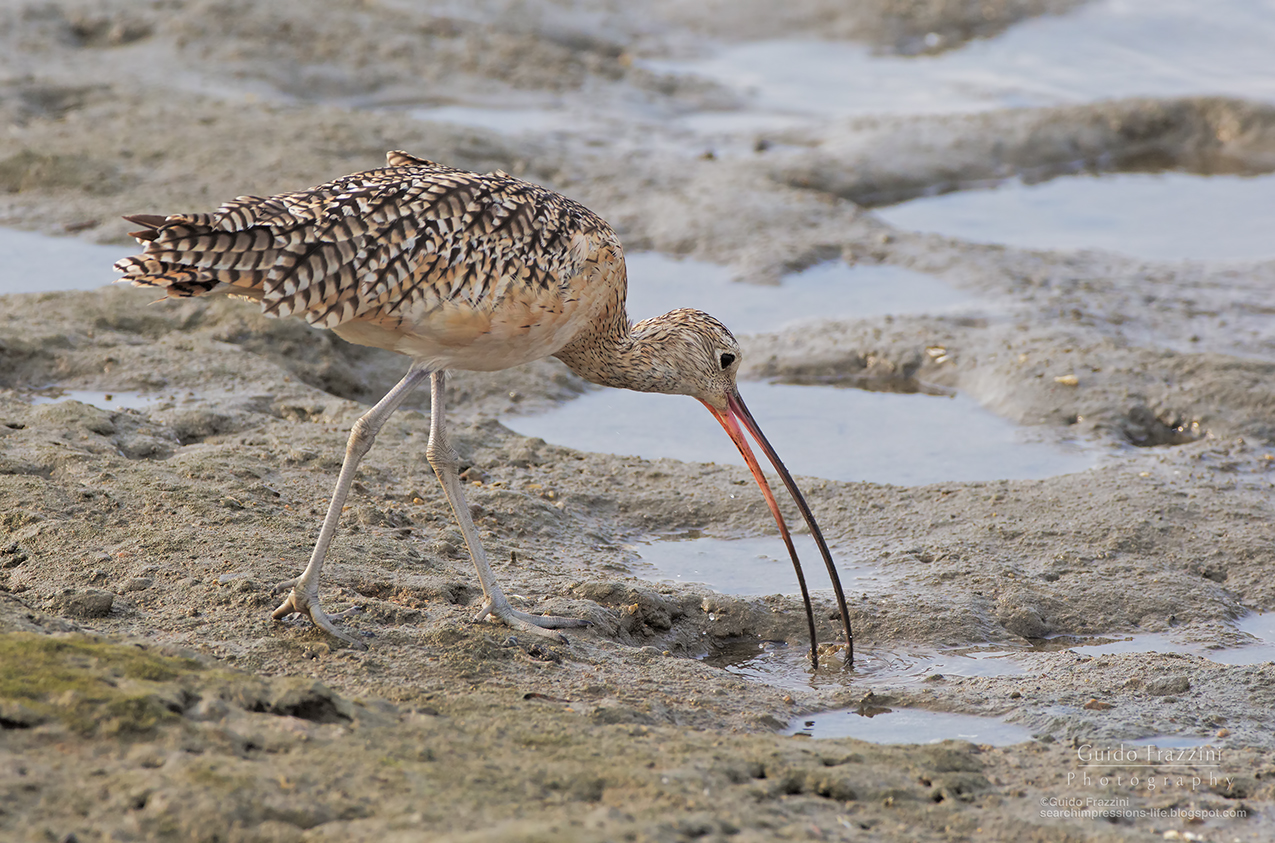
Dinner with the Long-billed Curlew

Browsing through some of my folders, I found some photos taken a couple of years ago at the Bolsa Chica Wetland Preserve, in California.
That day, I went to the wetlands around sunset, hoping to take some good shots of the many birds that can be found there. Sunset is a beautiful moment because of the light, the colors and it looks like many birds fish at that time of the day.

During my previous visit, I only had a quick glimpse of the Long-billed curlew, and that was certainly one of the birds that I was hoping to see. And this time I was lucky enough to spend quite some time with this one bird.


               560mm f/6.3 1/1250sec ISO640


               560mm f/6.3 1/1600sec ISO640


               560mm f/6.3 1/3200sec ISO1000 +0.33


               560mm f/6.3 1/1250sec ISO640


               560mm f/8.0 1/1600sec ISO800 +0.33


I had the opportunity to see it looking for food and capturing some crabs. The bird uses the very long and curved bill to probe the muddy ground close to the water to find crabs and small invertebrates. He also captures grasshoppers and other insects.

It was incredible to see the curlew turning its neck 180 degrees while trying to extract a crab from the mud, adjusting the proper curved side of the long bill to the situation: It really looked like a contortionist.

               560mm f/6.3 1/1250sec ISO1000 +0.33


               560mm f/8.0 1/800sec ISO800 +0.33


 Here a funny shot when the crab realizes that it's been discovered... It looks like it's saying: "Don't think it's going to be easy, man! I am not going down without a fight!" It's almost like having two knights fighting in a duel... who is going to win?

               560mm f/7.1 1/1000sec ISO640


But nothing could be easier for the long-billed curlew. Even though the crab is not a very small one, the long bill is a formidable weapon that the bird uses with incredible expertise.

               560mm f/7.1 1/1000sec ISO640


With a one-two move, the crab is made harmless. And after capturing it, there was certainly the need of washing the food before eating it! I was surprised to see the bird going to the water and letting the crab fall into it, just to immediately capture it again to wash all the mud off of it. The curlew was incredibly skilled in "handling" the crab with the bill, making it jump in mid-air to get it again in the correct position.

               560mm f/6.3 1/1600sec ISO640


               560mm f/7.1 1/1250sec ISO640


               560mm f/6.3 1/3200sec ISO1000 +0.33


               560mm f/8.0 1/1250sec ISO800 +0.33


Well, no more crabs... dinner time was finished for the day.

               560mm f/8.0 1/1250sec ISO800 +0.33


               560mm f/6.3 1/2000sec ISO640


               560mm f/6.3 1/2000sec ISO640


               400mm f/8.0 1/1600sec ISO800 +0.33


               400mm f/8.0 1/1250sec ISO800 +0.33


And after so much hard work, and a great dinner, finally some relaxation, getting ready to go to bed.

               400mm f/8.0 1/1600sec ISO800 +0.33


Sunday, February 21, 2016

Waiting for the Bearded Vulture

The Bearded vulture is a magnificent bird that is luckily regaining possess of the Italian Alps. He usually feeds on carcasses of dead animals, but rather than eating meat, his diet is mainly bone marrow. It lets the bones fall on the rocks down below to break them and eat the marrow inside.


Hoping to spot, and photograph, the Bearded vulture, Gipeto in Italian, yesterday I went with some friends to a location in the Piemonte Alps. Unfortunately the wind was extremely strong and that was probably the reason the bird of prey did not show up.


               Wind was particularly strong, especially as soon as we arrived...


But the trip was not totally "useless": the location was great and while waiting we were able to spot other animals worth shooting with our cameras – not to mention the "polenta and spezzatino" we had as a late lunch, when we got down to the village.

Some Chamois were looking for grass on the rocks, where there was less deposit of snow, showing their ability to climb very steep areas.


               800mm f/8.0 1/1000sec ISO500 +1


               800mm f/8.0 1/1000sec ISO1250 +1


                                      800mm f/8.0 1/1000sec ISO2000 +1.33


                                      800mm f/8.0 1/1000sec ISO1250 +1.33


               800mm f/8.0 1/1000sec ISO320 +1


               800mm f/8.0 1/1000sec ISO800 +1.33


Also, an Alpine chough kept flying over our heads to get down every so often, looking for food. This bird has a yellow beak and bright red feet and is very similar to the less common Red-billed chough, that has both bill and feet red.


               294mm f/8.0 1/1000sec ISO500 +1


               540mm f/8.0 1/1000sec ISO500 +1


And before we could even realize it, a large male Alpine ibex approached us from behind the big rock structure where we had stopped, and we were able to enjoy such a wonderful close encounter, for the few minutes the animal stayed in the area before disappearing from our sight. Both Chamois and Ibex are beautiful with their thick fur during the winter season; they will shed with the approaching of spring.


                                      400mm f/8.0 1/1000sec ISO1250 +1.33


               381mm f/8.0 1/1000sec ISO500 +1.33


               533mm f/8.0 1/1000sec ISO1600 +1


               533mm f/8.0 1/1000sec ISO1250


               381mm f/8.0 1/1000sec ISO800


Both the mammals and the Chough (this one especially) are pretty dark and taking pictures of them against the white of the snow requires compensation of exposure done in a proper way. Finding the right balance is key, in order not to have too much black for the animals and not loose all the detail of the snow at the same time.


Saturday, May 9, 2015

A Brief Encounter

Though the main purpose of this trip was to see and shoot the Black Grouse courtship activities during the peak of the mating season, the Swedish forest gave us the opportunity for a brief encounter with a nice little owl.
The Boreal Owl (Aegolius funereus), also known as Tengmalm's Owl, it is said to be very shy and elusive, so difficult to study and apparently not as much is known of this species, vs the other owls.

Our chance to take a picture lasted just a few seconds, the time the owl popped out of the hole in the tree to check who was out there. Not much light at that moment so the photo is a little grainy, but still I am happy to have been able to shoot this nice nocturnal bird.


              560mm f/5.6 1/500sec ISO 800 +0.67


              560mm f/5.6 1/500sec ISO 800 +0.67


             560mm f/5.6 1/500sec ISO 800 +0.67


Saturday, January 10, 2015

Woodpecker Feeder

I wasn't sure it would work, but it did! My first woodpecker feeder I built on the terrace was visited by the Great spotted woodpecker. I used a log, top part of a cut down tree, and tied it to the terrace railing. Some food in carefully drilled holes atracted the bird. I took many other pictures of woodpeckers in nature, but I consider this very special!


                                   400mm f/4.0 1/160sec ISO 1000 +1.67