It's in my blood.
Since I was given my first camera, when I was a little kid, I have always been fascinated by capturing in a shot what my eyes were seeing around me. The beauty of nature or the smile of a friend, an event or an emotion... Precious pearls to be framed in a photo. Whether freezing a movement or moving the stillness, looking at normality through a different angle or portraying the exceptional, I can choose different perspectives, I can catch reality. I think this passion is in my blood, I inherited it from my Grandpa and then from my Dad, and it has always had a great influence in my life. Come and follow me in my journey searching impressions of life.


Showing posts with label Canon. Show all posts

Sunday, April 16, 2017

The King

The Kingfisher, a blue rocket that dives at incredible speed and precision to catch the fish. This beautiful bird is not rare but being able to see it fishing is not that easy, especially considering its speed. I have seen this bird diving from the top of a big tree, 15 meters high, into a small pond and still catch the fish, of course all in a flash.

Taking pictures of the Kingfisher is great: the shape and colors of this bird make it a perfect subject for a nature photographer. However, even if a portrait shot is already a great picture – considering the beauty of this bird – taking a shot in flight is the ultimate goal of every photographer. And considering the speed of the Kingfisher, that is no easy task. So... of course I tried to do that.

Because of how fast it is, the camera must be set on a very fast shutter time – to be sure to freeze the bird's flight 1/3500-1/4000 sec is recommended – and it must be pre-focused on the spot where we think (or hope) the bird will dive. Autofocus would be really tough and all the water drops would anyway fool the lens view and make the camera focus off the real subject. The fast shutter time often prevents the photographer from being able to use a small aperture and depth of field is critical, especially when using a telephoto.

Here are my first results in this attempt of taking a good photo of the Kingfisher either diving or emerging from the water with the catch. The light was not that much, and to try and have a good depth of field I had to raise the ISO quite a bit. I even risked lowering the speed to a value, still pretty fast, but not completely safe. However, the fact that I took the bird while exiting the water, allowed for shots with no motion blur because the bird was slowed down by the fish and by the effort of flying out of the water.

They are not perfect, but I am pretty satisfied at the moment. And of course I will try again, looking for the perfect shot... wish me luck!


               350mm f/8.0 1/1250sec ISO6400 -0.33


               350mm f/8.0 1/1250sec ISO6400 -0.33


               350mm f/8.0 1/1250sec ISO16000 -0.33


               350mm f/8.0 1/1250sec ISO16000 -0.33


               350mm f/8.0 1/1250sec ISO16000 -0.33


Monday, March 28, 2016

Dinner with the Long-billed Curlew

Browsing through some of my folders, I found some photos taken a couple of years ago at the Bolsa Chica Wetland Preserve, in California.
That day, I went to the wetlands around sunset, hoping to take some good shots of the many birds that can be found there. Sunset is a beautiful moment because of the light, the colors and it looks like many birds fish at that time of the day.

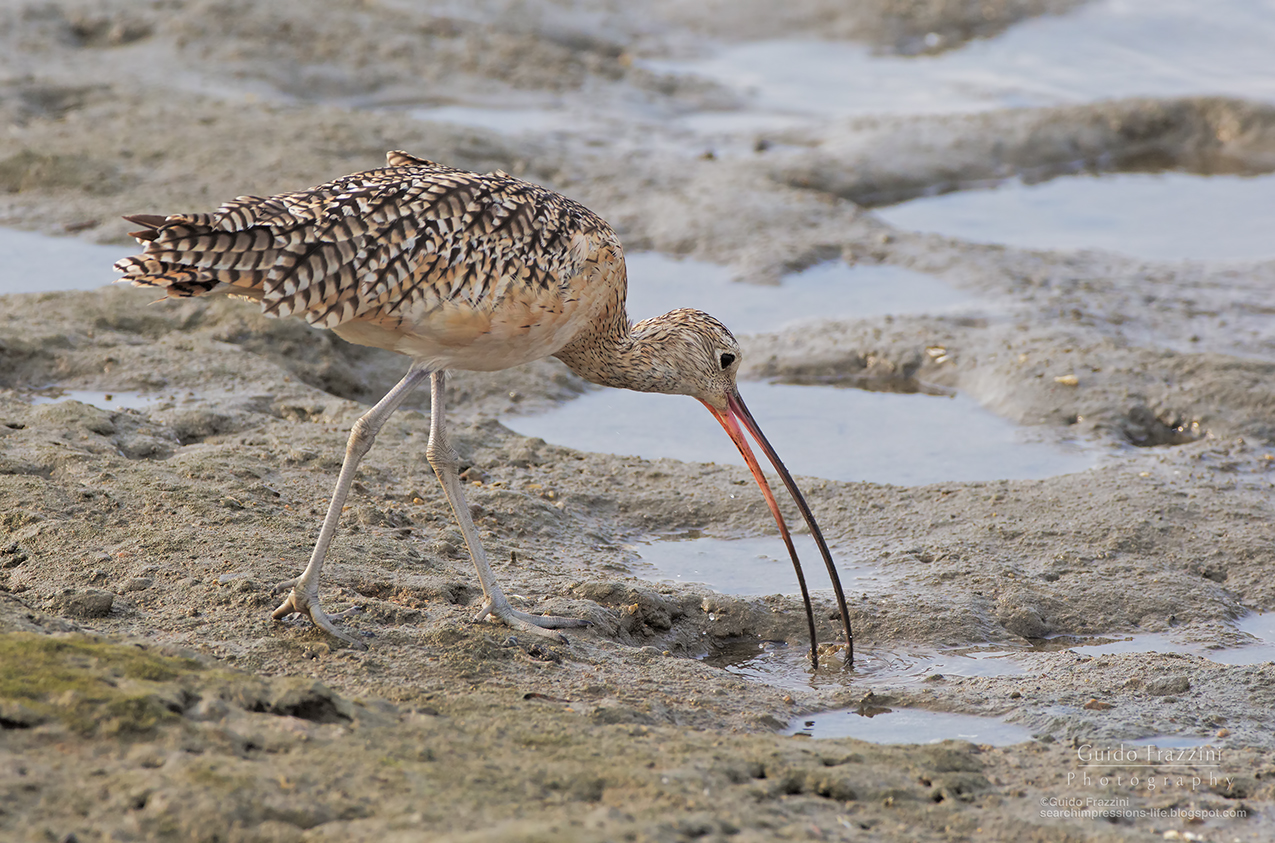
During my previous visit, I only had a quick glimpse of the Long-billed curlew, and that was certainly one of the birds that I was hoping to see. And this time I was lucky enough to spend quite some time with this one bird.


               560mm f/6.3 1/1250sec ISO640


               560mm f/6.3 1/1600sec ISO640


               560mm f/6.3 1/3200sec ISO1000 +0.33


               560mm f/6.3 1/1250sec ISO640


               560mm f/8.0 1/1600sec ISO800 +0.33


I had the opportunity to see it looking for food and capturing some crabs. The bird uses the very long and curved bill to probe the muddy ground close to the water to find crabs and small invertebrates. He also captures grasshoppers and other insects.

It was incredible to see the curlew turning its neck 180 degrees while trying to extract a crab from the mud, adjusting the proper curved side of the long bill to the situation: It really looked like a contortionist.

               560mm f/6.3 1/1250sec ISO1000 +0.33


               560mm f/8.0 1/800sec ISO800 +0.33


 Here a funny shot when the crab realizes that it's been discovered... It looks like it's saying: "Don't think it's going to be easy, man! I am not going down without a fight!" It's almost like having two knights fighting in a duel... who is going to win?

               560mm f/7.1 1/1000sec ISO640


But nothing could be easier for the long-billed curlew. Even though the crab is not a very small one, the long bill is a formidable weapon that the bird uses with incredible expertise.

               560mm f/7.1 1/1000sec ISO640


With a one-two move, the crab is made harmless. And after capturing it, there was certainly the need of washing the food before eating it! I was surprised to see the bird going to the water and letting the crab fall into it, just to immediately capture it again to wash all the mud off of it. The curlew was incredibly skilled in "handling" the crab with the bill, making it jump in mid-air to get it again in the correct position.

               560mm f/6.3 1/1600sec ISO640


               560mm f/7.1 1/1250sec ISO640


               560mm f/6.3 1/3200sec ISO1000 +0.33


               560mm f/8.0 1/1250sec ISO800 +0.33


Well, no more crabs... dinner time was finished for the day.

               560mm f/8.0 1/1250sec ISO800 +0.33


               560mm f/6.3 1/2000sec ISO640


               560mm f/6.3 1/2000sec ISO640


               400mm f/8.0 1/1600sec ISO800 +0.33


               400mm f/8.0 1/1250sec ISO800 +0.33


And after so much hard work, and a great dinner, finally some relaxation, getting ready to go to bed.

               400mm f/8.0 1/1600sec ISO800 +0.33


Monday, February 15, 2016

Long-tailed Tits Visiting the Feeder

The morning didn't look too bright... was it cloudy? I could not understand very well... I was thinking of going down to the feeder to take some shots, but I was about to change my mind: with no light, results would not be too good.

But after some time, the sun was rising over the horizon and I could see patches of blue sky getting larger and larger, so I decided it would be worth a visit.

I had just set up the hide, that a small group of Long-tailed Tits arrived. I love these birds, they are very cute and not particularly afraid of man. As their name states, their tail is very long, much longer than all the other tits, with which you can often see them. From my experience, they tend to stay in group of 6-7 birds. They didn't stop for long, but I was able to take a couple of good shots.


               560mm f/6.3 1/800sec ISO1250


               560mm f/5.6 1/640sec ISO1600


               560mm f/5.6 1/640sec ISO1600


  I would like to share a basic trick to take shots of the birds coming to your feeder. What you want to do is to attract the birds with some food and photograph them, possibly without showing the structure. A way to do that is to prepare a perch birds will use to approach the feeder. They would not need that – and even when that is there, not all use it – but most of the birds coming for food, would stop briefly on the perch, before getting to the tray where you have prepared nuts or seeds.

The way I prepared the set up, allows to change the perch easily to introduce more variety in your shots. On each of the two sides of a classic "little-house" feeder, I attached two clamps which can easily fasten a branch or other supports the birds can use. That way you can replace old perches and change them with new ones, adjusting the setting and look of your shots.

There will usually be just one or two seconds to take the shot, because the birds usually proceed right away to the feeder, but sometimes they stop on the perch for a little longer. A smart composition in camera or a crop done later in post processing and you will be able to take good photos in your back-yard.


Monday, February 8, 2016

Wild Horses of the West

Last summer, during our visit to Yellowstone, we took a detour to Cody because I wanted to photograph the wild horses. As you probably know, horses are not originating from America but were brought to the continent by the Spanish and then the British, so the ones we find today are descending from those first horses, probably groups left behind by the conquistadores or escaped and survived in the wild. Still, the wild horse has become such an icon of America and the wild west.

I heard about this group of horses not far from Cody, Wyoming, and thanks to the precious tips of Sandy Sisti we were able to spend some time with these wonderful animals.

That morning it was cloudy and we woke up with a light rain falling from the sky... the day was not starting in the best way. After driving for some time out of Cody, we reached a large kind-of-desertic area where we started our search. Our guide was driving a 4-wheel drive, the only possible way to reach the animals, but the rough terrain was giving everybody a hard time holding ourselves and trying not to bump our heads against the car roof because of the uneven "road" (if you can call it that way...).

Despite the flat appearance, the land was filled with small hills and valleys that made it difficult to spot the herd, so we drove up to the highest mesa to be able to have a good view, and from there we were able to spot them. It actually took some time to reach the horses, but after leaving the car, we got closer on foot. Our guide gave us some instructions and commented that, being the day not particularly hot, we would probably not encounter any rattlesnakes... While Denise thought "Thanks, God", I thought "Oh, too bad... I would have liked to photograph one!" Ha ha ha.

The horses were by a water pool, a precious spring to drink and resist the dry and hot climate of the area. Especially some of them were marked by a lot of scars, signs of the frequent hard fights among the stallions.
Unfortunately they moved pretty soon, and I wasn't able to take any particular shots... just a little fight, but from a distance, after they had already abandoned the water pool. At least the weather was getting better and we were gifted some sun and patches of blue sky. We tried again, got back to the car, and after another driving around, we were able to find the herd again, now calmly eating grass, under the attentive look of the stallion guarding the group.

It was already late and we had to leave soon. Too bad we had to go back without nothing really happening. Too short a visit to be lucky enough to get any dramatic shots, but I was happy anyway of the opportunity I had to see live these wonderful animals in the wild.


               560mm f/5.6 1/1600sec ISO320


               560mm f/6.3 1/1250sec ISO400


               560mm f/5.6 1/1250sec ISO400


               560mm f/5.6 1/1250sec ISO320


               560mm f/5.6 1/1250sec ISO400


               560mm f/5.6 1/1250sec ISO320


               560mm f/5.6 1/1250sec ISO320


               560mm f/5.6 1/1250sec ISO320


               560mm f/5.6 1/1250sec ISO320


               400mm f/5.6 1/1250sec ISO320


               560mm f/5.6 1/1600sec ISO320


Monday, February 1, 2016

Beautiful Robin

Especially during the winter, I like to take pictures of this beautiful little bird that often visits our gardens and feeders. It's extremely cute when it's cold and it "becomes puffy" fluffing its feathers to keep itself warm... sometimes it looks like a little feather ball!

It's very easy to spot, with the extensive orange area on its chest. That is actually also the only common visual trait with its American cousin, which share the same name, but belongs to a totally different family – you can see a couple of shots here. When I heard for the first time the other bird being called "robin" I was surprised to see a much larger bird and with such different plumage. The European species is the Erithacus rubecula while the American robin is the Turdus migratorius.

I see the robin most of the times alone, moving quickly in the bushes or on low trees, like many of the small birds do. It seems it likes to feed on the ground, mostly insects, but sometimes it doesn't disdain also hanging feeders.

So far not too much snow around, so I am still missing one classic shot of the bird in the snow, such an iconic image, representing often the Holiday Season in book illustrations, but I hope to get to it... one day.

And talking about book illustrations, I would like to dedicate this post and its photos to a friend of mine, Anna, a children's book illustrator who loves robins and all the other little friends from the woods. Enjoy.


               540mm f/5.6 1/800sec ISO1250 +0.67


               560mm f/6.3 1/1600sec ISO6400 -0.33


               560mm f/6.3 1/1600sec ISO6400 -0.33


                                    560mm f/6.3 1/1600sec ISO6400 -0.33


               560mm f/6.3 1/1600sec ISO6400 -0.33


               560mm f/5.6 1/800sec ISO5000 -0.33


               560mm f/5.6 1/800sec ISO3200 +0.33


               560mm f/7.1 1/2000sec ISO5000 -0.33


               560mm f/7.1 1/2000sec ISO3200 -0.33


               560mm f/6.3 1/1600sec ISO6400 -0.33


               490mm f/5.6 1/1000sec ISO1250 +0.33


               560mm f/5.6 1/800sec ISO1000 +0.67


               560mm f/6.3 1/1000sec ISO400


               800mm f/8.0 1/1600sec ISO800